It all began at 11 am on Tuesday outside Costa Coffee at the junction of Holborn, Kingsway and High Holborn. I had just purchased a coffee when I received a call from Harry telling me he had arrived. I guessed something was up. He normally texts me. I had arrived early because I had originally intended to visit Waterstones in Gower St to buy a book for our French trip. However the train into town was delayed and this left it too late to browse for a book and too early for our arranged start time.
In the end I needn’t have worried. Harry joined me for a coffee and we spent twenty minutes catching up before we started our adventure. Harry started suffering from a bad knee back in January and it has only got worse. He says he can only walk a couple of miles before it hurts. The tour of Bloomsbury that Harry has dug out should be within that length.
From Holborn Station we walked northward and then took the little pedestrian street called Sicilian Avenue. This small road led to be buzzing with small businesses, but now all the shops are closed. It is such a shame. When we came out into New Oxford Street I pointed the training room that once upon a time belonged to OTMA. We turned another corner and entered Bloomsbury Square.

The blue plaque on the wall belongs to the dermatologist Dr Robert Willan (1757-1812) who used to be a resident. Another resident on the same side of the square was Issac Disraeli a writer and father of the future Conservative Prime Minister Benjamin Disraeli.

Our journey continued as we walked northwards to Great Russell St where we turned left and then left again into Bury Place. We passed by the charming cafe and bookshop of the London Review of Books. A little further along the road I took a snap shot of Bertrand Russell.

Bertrand Russell shares the name and ancestry of the Duke’s of Bedford who own and developed a large proportion of Bloomsbury and Fitzrovia, which is why so many of the squares and roads have names associated with the family, such as Tavistock Bedford, and Russell. Bertrand was an intellectual heavyweight of the early part of the 20th century. I remember reading his book the History of Western Philosophy and seeing him march in the CND protests of the 1960’s.
Our route took us past St Mary’s Church in New Oxford Street, which is one of the best known of Hawksmoor’s Churches.
After walking up Museum St we wandered into Bedford Square where we found the Bedford College of Women, which is now part of the University of London.

Happy to find that the pioneer of women’s education had the same surname as myself, Elizabeth Jester Reid and that her bequest still provides a small endowment to women students.
After leaving one of the most beautiful squares in London we headed north again along Gower St. At number 10 the GLC erected a blue plaque to Lady Ottoline Morrell a society hostess who entertained a number of the Bloomsbury set including Virginia Woolf, Duncan Bell and Lytton Strachey as well as other contemporary artists like Stanley Spencer, Augustus John, Dora Carrington, and Henry Lamb. She had an open marriage and one of her long standing lovers was Bertrand Russell.

We turned off Gower St to pass through Senate House exiting into Russell Square. We turned left and headed to Thornhaugh St. The building on the corner of the Street and Russell Square housed the publisher Faber & Faber where TS Eliot worked for 40 years.

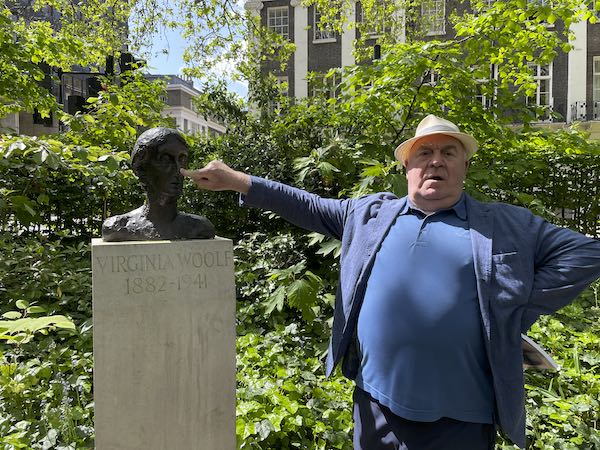
We followed on until we reached Gordon Square and turned right where we faced The Tavistock Hotel. The Hotel replaced previous building that was the last home of Virginia Woolf in London.


Virginia’s memory is well represented in Tavistock Square with a bust and picture.
Just to the east of Tavistock Square lies Gordon Square. Here a group of the Bloomsbury set used to live and co-habit. A leading member of the set, who never claimed to be an artist, John Maynard Keynes (1883-1946), spent his later years.

You can tell by the length of the Wikipedia entry for Keynes what a giant of 20th Century thought and economics he was. He only married at age 42 to a Russian ballerina, Lydia Lopokova. Prior to his marriage he had been almost exclusively homosexual. Several members of the Bloomsbury set had been his lovers, including Lytton Strachey, Clive Bell and Duncan Grant.
A few doors down lived Virginia Woolf, Clive Bell and the Stracheys.

On the other side of Gordon Square is a very interesting church which is open to the public. We entered and sat down for a few minutes of peace and quiet.

We returned to Gower Street and turned right to enter London University main entrance with it’s neo-classical style.

Backing out of the university we crossed over Gower St and passed along Grafton Way following this over Tottenham Court Road and into Fitzrovia.
On the right hand side of Grafton way are two plaques to South American liberation fighters Francisco di Miranda (1750-1816) and Andres Bello (1781-1865). Di Miranda fought in the American Revolutionary War, the French Revolution, and the Spanish War of independence. He died aged 66 in a Spanish prison. Bello was a Venezuelan-Chilean humanist, diplomat, poet, legislator, philosopher, educator and philologist, whose political and literary works constitute an important part of Spanish American culture.

Walk further along Grafton Way and into Fitzrovia Square. A beautiful square that unfortunately is not open to the public but provides another area of green in the centre of London. The square remains pretty much architecturally in tact. However cars have mostly disappeared from the square.

We left the and moved on to Cleveland Street where we had a meal in a greek restaurant. I ate a vegetarian moussaka.
We continued on the walk but there was little or no other interesting Bloomsbury information on the way.