
Met up with Garry on the tube at Pinner and we exited the underground at Charing Cross to walk to the Portrait Gallery to see the works of Eduard Munch.
I had thought about going there with jon about a month ago, but then the show had not yet opened and this was my first chance to go. The tickets worked out at £21 each. We made our way up to the 2nd floor to look at the exhibition and immediately I walked in I realised that this would not take very long as there were hardly any portraits on display so I determined to read all the biog and descriptions associated with the paintings.
Edvard Munch (/mʊŋk/ MUUNK;[1] Norwegian: [ˈɛ̀dvɑɖ ˈmʊŋk] ⓘ; 12 December 1863 – 23 January 1944) was a Norwegian painter. His 1893 work The Scream has become one of Western art’s most acclaimed images.
His childhood was overshadowed by illness, bereavement and the dread of inheriting a mental condition that ran in the family. Studying at the Royal School of Art and Design in Kristiania (Oslo), Munch began to live a bohemian life under the influence of the nihilist Hans Jæger, who urged him to paint his own emotional and psychological state (‘soul painting‘); from this emerged his distinctive style.
Travel brought new influences and outlets. In Paris, he learned much from Paul Gauguin, Vincent van Gogh and Henri de Toulouse-Lautrec, especially their use of color. In Berlin, he met the Swedish dramatist August Strindberg, whom he painted, as he embarked on a major series of paintings he would later call The Frieze of Life, depicting a series of deeply-felt themes such as love, anxiety, jealousy and betrayal, steeped in atmosphere.
The Scream was conceived in Kristiania. According to Munch, he was out walking at sunset, when he ‘heard the enormous, infinite scream of nature’. The painting’s agonized face is widely identified with the angst of the modern person. Between 1893 and 1910, he made two painted versions and two in pastels, as well as a number of prints. One of the pastels would eventually command the fourth highest nominal price paid for a painting at auction.
As his fame and wealth grew, his emotional state remained insecure. He briefly considered marriage, but could not commit himself. A mental breakdown in 1908 forced him to give up heavy drinking, and he was cheered by his increasing acceptance by the people of Kristiania and exposure in the city’s museums. His later years were spent working in peace and privacy. Although his works were banned in Nazi-occupied Europe, most of them survived World War II, securing him a legacy.
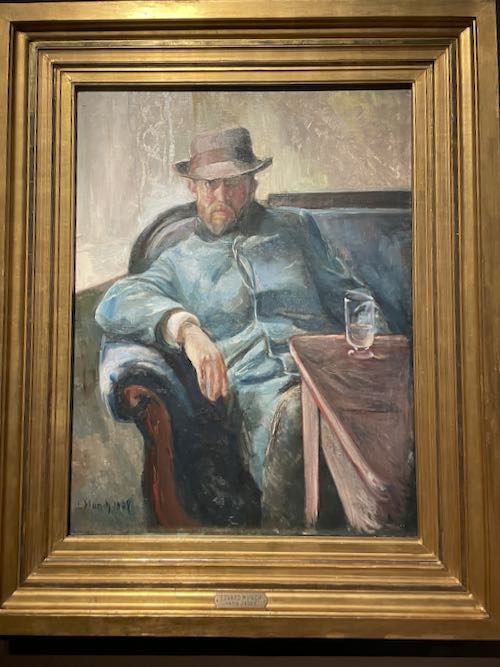
Hans Jæger
The writer and anarchist Hans Jæger (1854-1910) was a key figure among the Kristiania bohemians and the one who gave the group its name. He was an outspoken advocate of sexual freedom as relayed in his novel From Bohemian Kristiania, which was confiscated as pornography soon after its publication In 1885.
Munch’s portrait shows a cynical man slouched on a sofa in a comer of the Grand Café. The table opens up a gap between artist and sitter as if acknowledging a tension between them.
While Jager gave Munch the courage to write his Ilfe, Munch was also wary of falling too much under the older man’s influence.
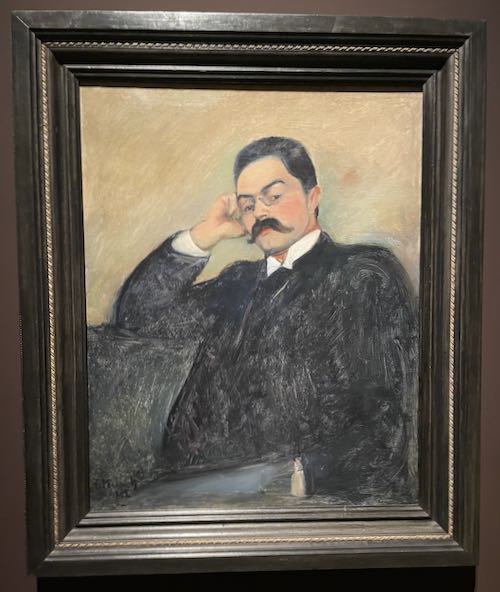
Thor Luken
The Lawyer, Thor Luken, (1863-1913) was a friend of Munch, with whom he spent summer months along the Oslo fjord. Munch painted this portrait to thank Luken for his professional advice. At first sight it appears to be simply a sympathetic portrait of a sophisticated man, but on close inspection, the bottom edge doubles up as a moonlit landscape (inhabited by two mysterious figures who could be lovers, or a symbolic portrayal of life and death). A picture within a picture, it is something very unusual to the rest of the portrait and shows how open Munch was to symbolist influences at this time.
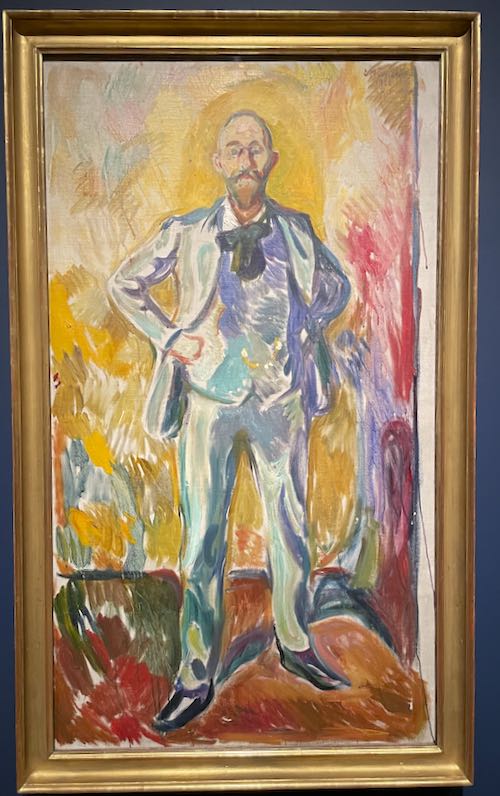
Dr Daniel Jacobsen
In 1908, Munch was admitted to the private nerve clinic in Copenhagen run by Dr Daniel Jacobson (1861-1999), after having suffered a breakdown due to alcohol polsoning. Although Munch recovered well, he was wary of what he perceived to be Jacobson’s controlling manner and took revenge with this portrait.
Painted with broad sweeps of the brush in wiid colours, it shows Jacobson standing In the pose of Hans Holbelns portrait of Henry Vill, as It engulfed by flames. As one of Munch’s most exprossive portraits, it completely bafled Jacobson who is reputed to have said, “just look at the picture he has painted of me, it’s stark raving mad.
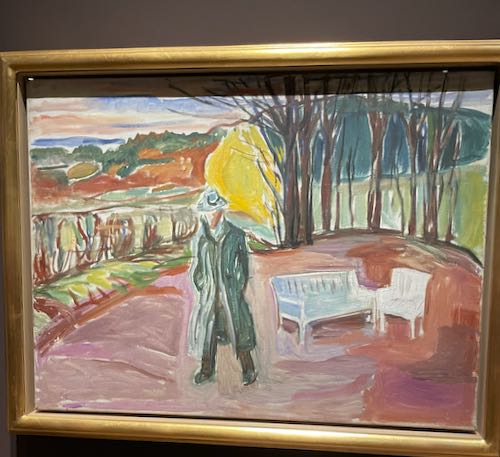
Self-Portrait by the Arbour
When German troops invaded Norway in 1940, Munch spurned all contact with the occupiers, retreating to his main residence at Ekely where he lived up to his death from pneumonia in 1944.
Here he became known as ‘the hermit of Ekely, even though he continued to receive friends and selected guests on a regular basis.
In this late self-portrait, Munch presents himself featureless and alone, walking in the arbour beyond his winter studio, deep in contemplation. While the empty seat and bench accentuate his solitude, the glowing yellow shrub and view of the landscapes to the distant Oslo fjord convey a feeling of oneness with the natural world.
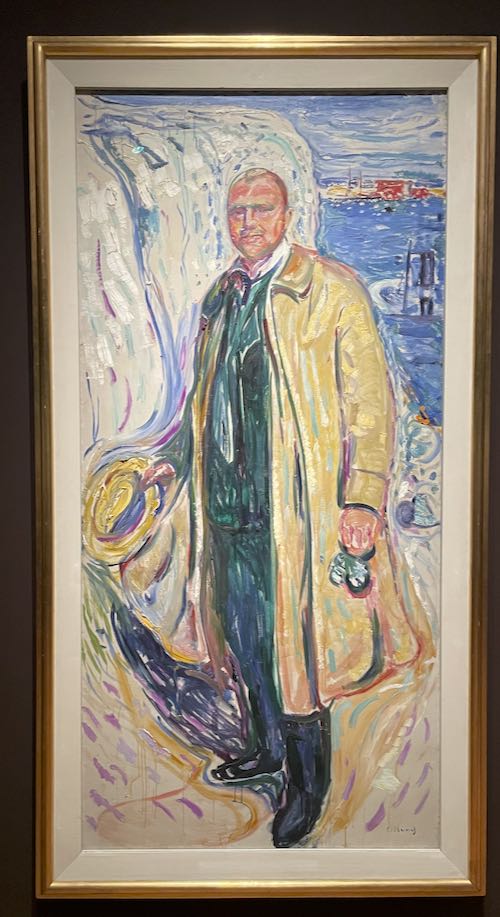
Christian Gierteff
Oll on canvas, 1809
The economist, town planner and writer Christian Gierlzff (1879-1962) was one of Munch’s close friends and advocates. He championed Munch during his life and the reminiscences he published after his death helped shape perceptions of the artist as both an outsider and a national icon.
Gierleff spent much of his life in Kragere, the small coastal town Munch settled in upon his return to Norway and where he painted this portrait. Gierloff is shown standing near the harbour with a steep rockface behind him. It is painted with verve and confidence with drips and detached strokes of paint lending energy to the composition.
“I really understand the desire to paint an old friend, sometimes when I’m lost or confused I’ll paint a close friend… to ground myself.”
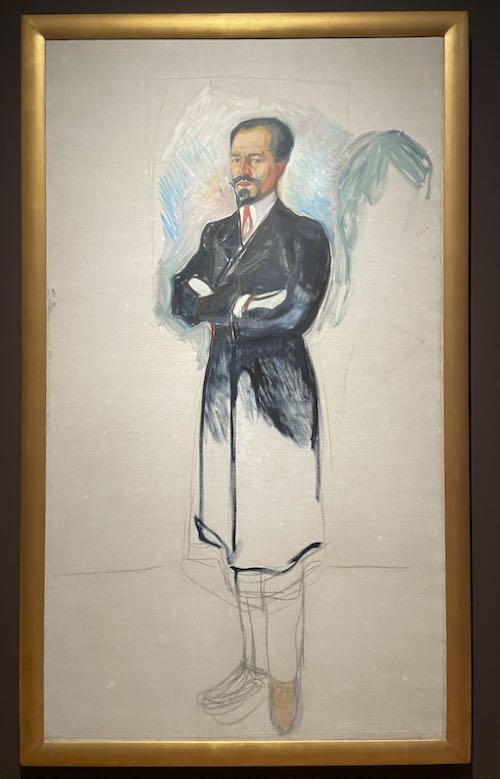
Ernest Thiel
Oil on canvas, 1907
Together with Linde, Ernest Thiel (1859-1947) was Munch’s most important patron during the early 1900s, by which time he had established his own bank in Stockholm and was one of the wealthiest men in Sweden. He also championed the writings of Nietzsche, translating his work into Swedish.
Munch’s unfinished portrait shows a proud, self-made man, the embodiment of Nietzsche’s ‘will to power’ standing in a rather haughty, defensive pose.
According to Christian Gierloff, there was something in Thiel’s personality that agitated Munch to the extent that he was overcome with anger while working on the portrait and, to the shock of the sitter, ‘put his fist straight through it and sent the easel dancing across the floor’.
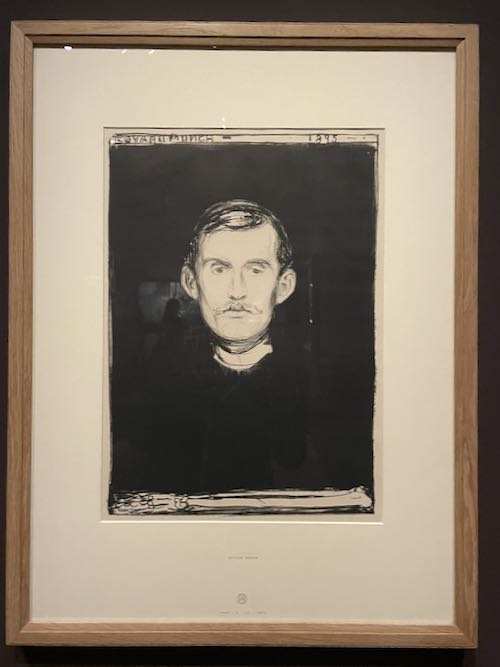
While the exhibition didn’t prove to be good value for money the images that Munch created demonstrate what a fabulous artist he was. I enjoyed looking at his portraits and wish that they had also included The Scream.
We pottered around a couple of rooms at the Gallery after the show and then Garry announced that he had to be home by 2 pm which didn’t leave much time for anything else. This sudden announcement surprised me. We normally get back from a day’s excursion between 3:30 and 4:30. Apparently Jane had ordered fish to be delivered for 2 pm and she wanted to go out at 2 pm. Why she couldn’t hang around for the delivery i don’t know and I didn’t have the cheek to ask.
We had a quick pint in The Harp before we started to look for a bite to eat. Neither of us wanted a proper meal, just a sandwich we eventually found a cafe on The Strand and I chose a sausage sandwich and a cup of tea. The cost for the two of us was £28. We then returned by tube to home.