Met up with Harry at Sloane Square tube station for a Hidden London Walk around Belgravia. Belgravia as one of the riches districts of London has lots of famous inhabitants since the area developed by the Grosvenor family in the 18th C.
Before we started we had our traditional coffee just close to the station where we caught up with our events. I told him about my medical adventures and he recounted his disastrous visit to see Amy in Amsterdam. He has real trouble accepting the bad behaviour of his grandchildren.
Belgravia is named after the small village of Belgrave in the county of Cheshire. Belgrave is situated on the Eaton estate whose principal residence, Eaton Hall, has long been the country seat of the Grosvenor family, currently headed by the 7th Duke of Westminster. There are few areas of London so associated with a single family, and Belgravia owes not just its name, but its very existence to the patronage of the Grosvenor family.
The Grosvenors came to England with William the Conquerer in 1066 and were just another aristocratic family util 1677, when the Cheshire baronet Sir Thomas Grosvenor married 12 year old Mary Davies. Mary brought with her a dowry that included several hundred acres of underdeveloped fields that were part of Ebury Manor. These fields would later be developed into Mayfair, Pimlico and Belgravia. However, in the 17th C the land here was mostly used for grazing and was intersected by rough roads that were plagued by thieves.
The Grosvenor family cleverly held onto these fields just as the capital began to spread westwards. The great fire of London in 1666 and a surging population meant that large scale planned residential developments became common. These were primarily aimed at the wealthy who desired to live on well planned new estates. The development of Belgravia began in the 1820s for these rich citizens.

We began our walk in Bourne St named after the Westbourne River. This is a lost London river forced underground which begins in Hampstead and travels across Sloane Square until it emerges at the Thames just near Chelsea Bridge. A first indication of the wealth of the area comes early with the notification of the Tradesmen’s Entrance at no 93. To help the spiritual life of the area several churches were constructed and example is St Mary’s Bourne St. squeezed between residential property on either side and contracted in 1874.

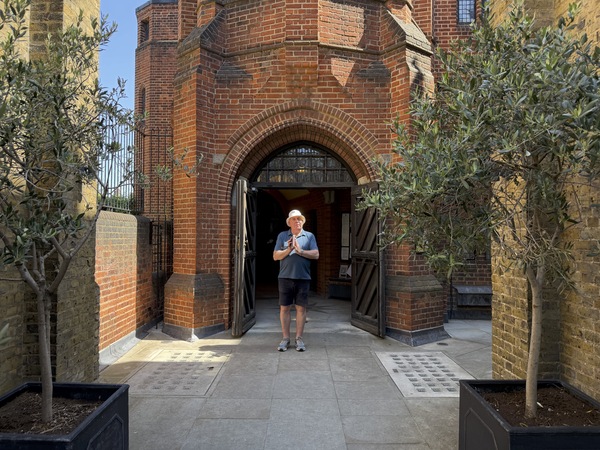
We wandered down to the busy Pimlico Road and sat down in a triangular area known as Orange Square in the shade to read a new section of the book. Wolfgang Amadeus Mozart stayed in the area when he was 8 in 1764 and composed his first symphony by the time he left after a few weeks. This statue commemorates his stay/

We continued a short way along Ebury Street where Ian Fleming, Sir Oswald Mosley, Michael Caine, Terrence Stamp, Noel Coward and the street also features an ex-CIA safe house. Many of the roads and squares in the area bear the title Eaton which is one of the subsidiary titles of the Grosvenor’s. We then arrived at Chester Square, one of the more charming and quieter squares in Belgravia. The square has consistency topped the list of the most expensive addresses in the UK.

Notable residents of the square include spy Guy Burgess, Marry Shelley (author of Frankenstein) Percey Shelley, Prime Minister Harold Macmillan, poet and critic Matthew Arnold, and Prime Minister Margaret Thatcher. We followed the route and arrived at Eaton Place home of the notorious escape artist Lord (lucky) Lucan who killed his nanny and subsequently disappeared in November 1974.
The area is amass of large expensive buildings. Nowadays even the old servant’s quarters are sold for ridiculous sums of money. Tucked away behind the large and gaudy new classical residences are the mews and former stables. These provide a quieter living space than many of the busy roads than run through Belgravia.
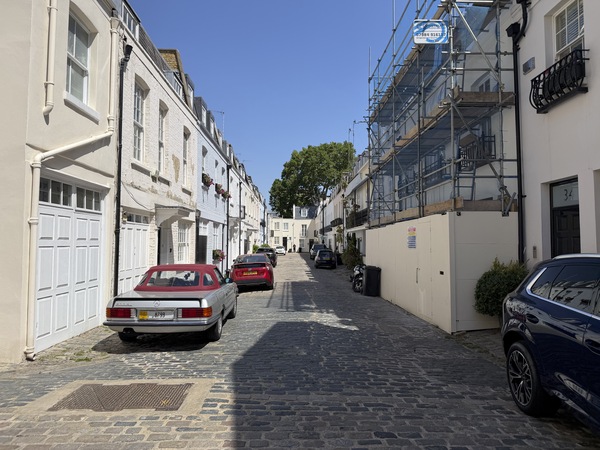
By the time we arrived in Eaton Mews North we had almost finished our trip and we wanted to find a pub for a bite to eat and a drink. We settled on The Alfred Tennyson on Kinnerton Street. A very welcoming staff greeted us and I had a tomato juice while Harry slowly downed a pint. We both decided to have the cheapest item on the menu, sausage and mash at £16.95. Harry’s first4 comment on biting into the sausage was “this is hard to chew’. we didn’t stay for a second drink.

We didn’t walk far before our next stop at The Grenadier in Wilton Row. The book describes it as “One of the most charming (and hidden) posh pubs in London – it has also long enjoyed a reputation as being one of the most haunted. Wilton Row was built in the late 1820s as a service road for the grander neighbouring streets, an the Grenadier dates from the same tim, although legend that it began its life as an officers mess for the nearby barracks is probably not true – it was meant to be a public house all along.
Harry indulged in another pint in this busy watering hole full of tourists. I guess it must sit on some guided tour. Being so hidden its unlikely that so many visitors would find it by accident. I ordered a refreshing cranberry juice which slipped down a treat. I must chose this again. From here we wound our way to Knightsbridge and up to Hyde Park Corner where Harry and I parted ways. I took the 74 bus to Baker Street and the from there the tube home.
When I arrived in Pinner the annual fair had already started and plenty of people milled around. I wasn’t tempted to try the dogems or the helter skelter or any other of the many rides on offer.
